
This last topic is an important one these days, since there seems to be confusion both inside and outside the Church about what is authentically Christian. I decided to use the Mormon religion as a way to talk about this confusion, given many have come to assume it is a sect of Christianity, much like another denomination like the Southern Baptist Convension or Catholicism of Lutheranism.
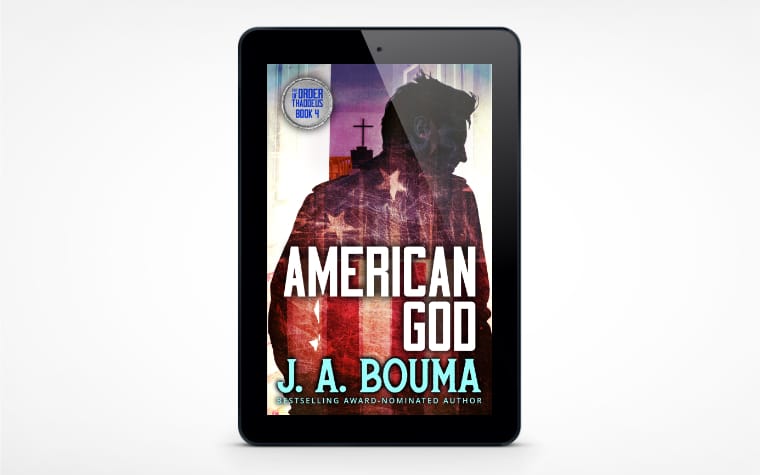
Here’s the thing: it is not Christian. The history of mormonism and its founder, as well as the theology of the religion makes this clear. I draw out some of this history and theology in American God, which reflects my goal as an author to root all of my stories in a solid bedrock of historical and religious facts. When it comes to Mormonis, those facts are surprising, but nonetheless 100% accurate, which I include in an author’s note at the end of the book of which this article has been adapted.
If you’re interested in learning more about this religion and how it compares with historic Christianity keep reading.
Not only will you better understand how it was formed and why, you’ll learn what Mormon’s believe and how this compares with authentic Christianity.
MORMONISM AND HISTORY
One of the interesting pieces of the history of the Shroud is that before the image was widely known beginning in the sixth century, icons or images depicting the so-called Savior looked dramatically different. Pre-sixth century images of Jesus were missing the beard, his hair was short, and he looked baby-faced. Almost angelic. After the sixth century when the image was more widely known the icons changed.
Such religious images depict Jesus with a long beard, hair long and parted down the middle, and with a man’s face looking oddly similar to the image on the Shroud. This gives anecdotal evidence to not only how the Shroud impacted the early stages of Christianity. But also the story itself, of its origins in Edessa as told by the venerable early Church historian Eusebius.
MORMON THEOLOGY vs. AUTHENTIC CHRISTIANITY
That story about the Image of Edessa or Mandylion recounted by Silas Grey and Rowen Radcliffe in the book is true. Eusebius recalled the account about the ancient King of Edessa who had sent a letter to Jesus inviting him to visit. There was a more personal motivation to the invitation, though: he was suffering greatly from an incurable disease. And he had heard about the many miracles Jesus had performed south of his kingdom in Judea and Galilee.
So he wanted in on the action.
Who could blame him? Unfortunately, as the story goes, Jesus declined, but he promised the king that he would send along one of his disciples to cure him after his mission on earth was complete. And he did. Jesus’ disciples sent Jude Thaddeus, who had healed many while in Edessa. He also brought along with him something extraordinary: a linen cloth with a stunning likeness portrayed on its surface.
Again, Radcliffe’s reciting of the tenth-century account of the Shroud is real:
And so, receiving the likeness from the apostle immediately he felt his leprosy cleansed and gone. Having been instructed then by the apostle more clearly of the doctrine of truth he asked about the likeness portrayed on the linen cloth. For when he had carefully inspected it, he saw that it did not consist of earthly colors, and he was astounded by its power.
Subsequently, the linen travelled around the world to various sites, including Constantinople where it is thought by many to have ended up in the care of another religious order: The Poor Fellow-Soldiers of Christ and of the Temple of Solomon, also known as the Order of Solomon’s Temple. And better known as the Knights Templar or simply as the Templars. The opening prologue somewhat reflects this genuine historical account of the Templars possession of the Shroud, and their eventual demise.
But that’s not all, because all of the physical properties of the Shroud are 100% real and scientifically validated. Here are ten more reminders of the fascinating facts giving scientific and historical credence to the Shroud of Turin.
Central Mormon Beliefs
God: There are many gods, which is polytheism. The god of this planet is an exalted man with a body of flesh and bones. He has at least one wife, probably more.
Pre-existence: Humans have pre-existed in heaven as spirit children conceived via celestial sex between Heavenly Father and Heavenly Mother. Our actions in the pre-existence determine our race on earth.
Human nature: Mormons say they are gods in embryo, and they have not yet reached the godhood. “As man is, God once was: as God is, man may become.”
Jesus: Jesus, the first spirit-child of Heavenly Father, is the spirit-brother of Lucifer. Jesus is only one of many created gods.
Eternal Life: There are three levels of eternal life, the highest level being godhood, which is available only to perfected Mormons.
Salvation: Salvation is achieved only by those who do enough good deeds and obey all God’s laws, which amounts to works righteousness.
Holy Spirit: A third god, like Heavenly Father and Jesus, with a spiritual body only, rather than a physical body.
The Bible: It isn’t infallible, inerrant, or inspired. It is also incomplete, not containing God’s full revelation.
Central Christian Beliefs
God: There is only one God, which is monotheism. God is not a man, nor does God have a body. God is not married, which is not even hinted at in the Bible.
Pre-existence: Christians are children of God by adoption to sonship and daughtership through faith. One’s spirit is formed on earth as they begin life within the womb. God is no respecter of persons and the Christian faith does not favor a single race; there are no racial distinctions within Christianity.
Human nature: We are created beings created in the image and likeness of God, whom he longs to be in covenanted relationship with. However, we are separate from the Creator; we do not become God(s).
Jesus: Jesus is not a created being, but rather, is the Creator—by whom, through whom, and for whom all things were made. As the central Christian creed says, the Nicene Creed: And in one Lord Jesus Christ, the only Son of God, begotten from the Father before all ages, God from God, Light from Light, true God from true God, begotten, not made; of the same essence as the Father.
Eternal Life: There exists no other gods, nor can any person become a god, no mater how dedicated they are to the church. All people will be separated at the end of the age: some granted eternal life through faith in Jesus; others damned to eternal death through rejecting Jesus.
Salvation: Salvation is not achieved or obtained through good deeds and works of righteousness, but by simply asking God for forgiveness of sins, trusting Jesus’ ransom payment for personal sins on the cross, and submitting ones life to God in faith and obedience.
Holy Spirit: The Holy Spirit is God, the Third Person of the Trinity, co-equal and co-eternal with God the Father and God the Son. He is not a separate entity, but one being with the Father and the Son.
The Bible: It is infallible, inerrant, and inspired. It is also complete, containing God’s full revelation and complete gospel of salvation.
The contradictions between Mormonism and authentic, historic Christianity become starker when it comes to Jesus (ONUG, 378).
Mormon Beliefs about Jesus:
A literal son (spirit child) of a god (Elohim) and his wife.
The elder brother of all spirits born in the pre-existence to Heavenly Father.
A polygamous Jew.
One of three gods overseeing this planet. • Atoned only for Adam’s transgressions by sweating blood in Gethsemane.
The literal spirit brother of Lucifer.
Jesus’ sacrificial death is not able to cleanse every person of all their sins.
There is no salvation without accepting Joseph Smith as a prophet of God.
Christian Beliefs about Jesus:
The uncreated, eternally existent, unique incarnation of God as “the Son.”
The unique Son of God, with whom none can be compared.
An unmarried Jew.
The Second Person of the Holy Trinity.
Atoned for everyone’s personal sins by being crucified on the cross.
No relation to Satan, who is a mere angel.
Jesus’ sacrifice on the cross is able to cleanse every person of all their sins.
Jesus alone is the way, truth, and life. No need to recognize or follow a prophet.
The conclusion, then, is that Mormons do not believe what Christians believe; Christians do not believe what Mormons believe. But why does this matter?
What I conclude...
His closing statement at a critical juncture in the story differentiating between the questions ‘Are Mormons Christian?’ and ‘Are Christians Mormons?’ was borrowed from Abanes’s book. It is a helpful distinction, for it gets to the heart of the matter: do people who call themselves Christians believe what Mormons believe? Has the Church of Jesus, the one that has existed for the last two millennia ever believed at all what the Church of Jesus Christ of Latter-day Saints believe—which has only been in existence for less than 200 years? As you can see from the brief survey of Mormon theology and Christian theology above, the answer is a resounding “No!”
So if Christians don’t believe what Mormons believe, and we could never say that a Christian is a Mormon, why would we ever insist on the reverse? As Silas said, that would be like saying a Muslim Christian. Muslims do not believe what Christians believe; Christians do not believe what Muslims believe. Neither of those are controversial statements; they are factual ones. So why would we suggest the same for Mormons? The core tenets of the Mormon faith contradict the core tenets of the Christian faith. Which is precisely what Joseph Smith had in mind in the first place.
Interestingly, he founded the alternative religion in direct response to historic Christian orthodoxy, which he saw as the “Great Apostasy.” As the official Mormon version of Smith’s supposed First Vision states, as well as other statements from the Book of Mormon and Doctrine and Covenants:
“I saw a pillar of light exactly over my head…I asked the personages who stood above me in the light, which of all the sects was right—and which I should join. I was answered that I must join none of them, for they are all wrong, and the personage who addressed me said that all their creeds were an abomination in His sight: that those professors were all corrupt.” All other churches, he insisted in the Book of Mormon, were founded by the devil and representations of the “great and abominable church” of the satanic world system. He wrote: “Behold there are save two churches only; the one is the church of the Lamb of God, and the other is the church of the devil…the whore of all the earth” (1 Nephi. 14:10). And as Abanes reveals: “Mormons have repeatedly confirmed that their church is ‘the only true and living church upon the face of the whole earth’ and that ‘the power of God unto salvation—(Rom. 1:16) is absent from all but the Church of Jesus Christ of Latter-day Saints’” (378).
Add to this the occult angle of Joseph Smith and his family documented in chapter 16 (which was drawn from primary sources quoted in Richard Abanes’s resource, leaving little doubt that Smith Junior was deeply entrenched in occultism along with his family), and the entire foundation of the upstart religion is questionable. At every turn, Mormonism contradicts and compromises beliefs that have always been central to the Christian faith. It truly is a man-made religion offering an American god, bearing no resemblance to authentic Christianity.
Aside from the conversation about Mormon beliefs, there is growing confusion within the Church about what is authentically Christian. I hope this story will help others better understand this confusion and what Christians have always believed, in addition to considering how the Church compromises the integrity of those beliefs by aligning so closely with the State—for it is only in independence from the State that the Church can bear prophetic witness against it. And as Saint Jude Thaddeus insisted in his letter to Christians living in Asia Minor, there is a once-for-all-faith that has been entrusted to God’s holy people. It is our job—the Church’s generally and Christians’ specifically—to contend for it.
Abanes, Richard. One Nation Under Gods: A History of the Mormon Church. New York: Four Walls Eight Windows, 2002. www.bouma.us/mormon1
Palmer, Grant. Restoring Christ: Leaving Mormon Jesus for Jesus of the Gospels. Self-Published, 2017. www.bouma.us/mormon2
Statement from the Smithsonian Institution regarding the Book of Mormon: www.bouma.us/mormon4
Read the book inspired by faith + history
American God | Order of Thaddeus 4
Join My Reader Club. Get a Free Book
- Exclusive discounts and special offers
- Early access to new books or events
- Behind-the-scenes articles, updates, and inspiration