
Why is this?
Part of it is the fact that every one of us is born with a heart primed for such wickedness, having inherited a sinful nature from our original ancestor Adam. Yes, we still bear the image of our Creator. But that image is broken and busted beyond all self-repair; we truly are desperate for a heart transplant, which Christ offers freely through his rescue mission on the cross.
However, there is another reason: the reality of Satan and presence of demonic darkness in the world. We moderns, in all of our sophisticated rationality and demand for naturalistic causes, have generally written off such supernatural manifestations—both outside and the Church, but inside as well. And with disastrous consequences.
I’m not one to find the Devil hiding under every rock and cautious to ascribe every evil act to him, but I cannot help but think that much of the wickedness we find in the world has far more demonic and Satanic designs behind it than we give it credit. So I thought, why not write a book that would attempt to clue people into these demonic dimensions and the clear and present dangers that the cosmic powers of this present darkness, the spiritual forces of evil pose to the world?
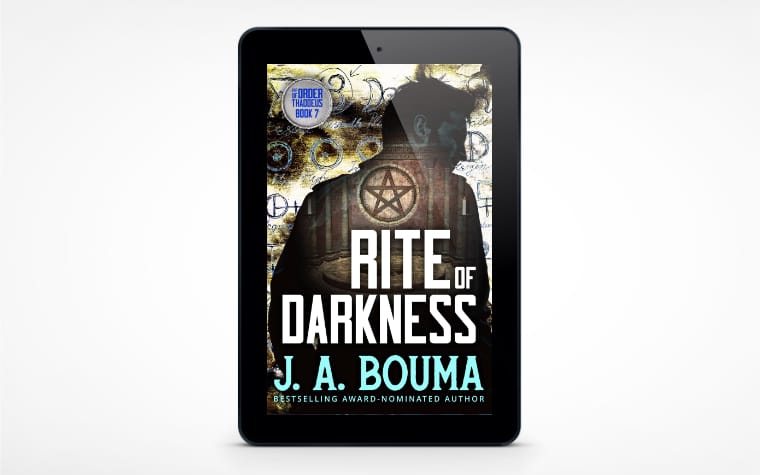
I wrote Rite of Darkness, the seventh book in my action-adventure religious thriller series Order of Thaddeus that plumbs the depth of the demonic and occult, and the Church’s healing deliverance through exorcisms.
And 9 things you need to know about the demonic.
1) The Devil Plays a Major Role in the Bible and Christian Teaching
One of the interesting pieces of the history of the Shroud is that before the image was widely known beginning in the sixth century, icons or images depicting the so-called Savior looked dramatically different. Pre-sixth century images of Jesus were missing the beard, his hair was short, and he looked baby-faced. Almost angelic. After the sixth century when the image was more widely known the icons changed.
Such religious images depict Jesus with a long beard, hair long and parted down the middle, and with a man’s face looking oddly similar to the image on the Shroud. This gives anecdotal evidence to not only how the Shroud impacted the early stages of Christianity. But also the story itself, of its origins in Edessa as told by the venerable early Church historian Eusebius.
2) The Devil Plays a Major Role in Our Lives
Part of the result of this fallen world and fallen humanity is that Satan has been given some degree of dominion over our world, over our lives. The Gospel of John calls him ‘the ruler of this world’ and Saint Paul referred to him as ‘the god of this world’ in 2 Corinthians. While God is the ultimate ruler and ultimate authority over the universe and everything in it, including the Devil. Satan still retains his former angelic stature and powers and rule. Although, as Saint Augustine taught, God does not give Satan free rein and a free hand, otherwise no man would be left alive.
3) The Devil and the Fallen Angels Are Limited in Their Actions
The Devil is also limited by God’s own will. Again, the Devil is a created being, not the Creator. Which means his status as a lower being is as a creature, far beneath that of God Almighty. He is often falsely represented as a sort of god of evil, a view held by many satanic cults. The clash of good versus evil in many pop culture phenomenons often pits good against evil, or God against the Devil, as equals. Which is fundamentally not true. Even though the Devil, because of his angelic stature, has more power than humans, he can do nothing unless God allows it. The Book of Job, chapter one, makes that clear: ‘The Lord said to Satan, Very well, all that he has is in your power; only do not stretch out your hand against him!’
4) Demons Use Doorways to Take Possession of a Person
5) A Major Doorway into Demonic Possession is Sexual Abuse.
6) A Second Major Doorway for Demonic Possession is the Occult
7) Apparently, Christians and Non-Christians Can Be Possessed
[People of every faith or none. The Devil does not look in the face of everyone.] No one can consider themselves excluded: they can be young or old, believers or atheists, Christians or those of other religions….Not even consecrated religious are ruled out. I recall the case of Sister Angela, who was obsessed with a cursing that resounded in her mind. In most cases, those who are distant from the Faith are more susceptible to this risk, but this is only an indication of the maxim that says the Devil is more tranquil if he does not have to live with prayer, fasting, the Eucharist, and the other sacramental practices. (67)
8) Demons Possess the Person not the Soul
Without a doubt, diabolical possession, the invincible influence of the Devil on a person, is the most striking and serious form of the extraordinary action of the Devil. When the demon is able to take possession of a person, he can make him say and do what he wishes. It is necessary to clarify that the Devil is not able to take possession of the soul of a man (unless the person expressly consents to it), but only his body. (66)
He also goes on to say that cases of vexation, obsession, infestation, and oppression are far more common than actual possession, and is seldom permanent.
9) The Bible Shows Followers of Jesus Becoming Filled with Satan
Then there was Ananias, another disciple of Christ from the Book of Acts whom Luke quotes Peter asking, ‘why has Satan filled your heart to lie to the Holy Spirit,’ (Acts 5:3) suggesting a contrast of two ‘fillings’—between Satan and the Spirit of God, even within believers. And pointing to this reality of demonic influence within the life of the believer, even on top of temptation and oppression.
10) Exorcisms Was a Major Feature of Jesus’ Ministry and the Disciples
If anyone needs evidence of the necessity of the ministry of deliverance offered by exorcists, then look no further than Jesus!
Exorcism was a central feature of his ministry, and the New Testament is full of stories where Jesus offered deliverance to those afflicted by demonic possession—one of the more dramatic is Mark 5:1-20. This not only proved his divinity, but was also a tangible representation of his mission to defeat the kingdom of Satan and usher in the kingdom of God. As Matthew’s Gospel records: ‘But if it is by the Spirit of God that I cast out demons, then the kingdom of God has come to you’ (Matthew 12:28).
Matt Baglio in his book The Rite describes Jesus’ ministry in this way:
Although Jesus was not the only exorcist of his day, his method was special. Rather than using the complex rituals and props of his contemporaries, he simply ordered the demon to depart, sometimes even in the first person. In fact Jesus’ exorcisms were considered so radical that he was accused by his enemies of harnessing the power of demons (Mark 3:20–30), a charge Jesus answered by saying simply that it was impossible for a demon to cast out a demon. (34)
This ministry also extended to the disciples. ‘Then Jesus summoned his twelve disciples and gave them authority over unclean spirits, to cast them out, and to cure every disease and every sickness’ (Matthew 10:1). Luke 10:17–20 records seventy-two disciples returning joyfully to tell Jesus that ‘even the demons are subject to us because we use your name!’ This ministry continued after the Church was established, where Acts 8:5-7 records ‘unclean spirits, crying with loud shrieks, came out of many who were possessed’ when ‘Philip went down to the city of Samaria and proclaimed the Messiah.’
This deliverance ministry known as the Roman Ritual or the Rite has continued throughout the Church’s history. However, this is where my Catholic brothers and sisters have a leg up on us Protestants (of which I consider myself), who have traditionally been far more intentional about naming possession and offering healing. They offer a deliberate process for discerning, identifying, confronting, and releasing people from demonic possession I found inspiring.
11) There Has Been a Resurgence of Exorcists and Requests for Exorcisms, Brought on by a Resurgence in Magical Thinking
As people’s participation in orthodox Christianity declines, there has always been a surge of interest in the occult and the demonic. Yet there is a hunger for contact with the supernatural, even as the thirst for Christ’s font has waned, and people have begun to look for their own answers. At the same time, there has been a resurgence in magical thinking through American culture, with the rise of movies and TV shows touting the supernatural, and other media about demons and the demonic.
Such books and films may seem innocent on the surface, but they are far more devious and dangerous. They have disarmed Americans from the reality that all magic is darkness and not of God, regardless if it is conjured by twelve-year-old wizards-in-training or sixty-year-old witches and warlocks from an urban coven.
The final word...
For our struggle is not against enemies of blood and flesh, but against the rulers, against the authorities, against the cosmic powers of this present darkness, against the spiritual forces of evil in the heavenly places. Therefore take up the whole armor of God, so that you may be able to withstand on that evil day, and having done everything, to stand firm.
May we take deliberate steps to guard ourselves against these forces by taking up the armor of God, standing firm during our hour of oppression and testing. And may we also recognize the forgiveness and healing available to all through the freeing power of Jesus Christ when allow wickedness to take hold in our lives—regardless of its form.
Amorth, Gabriele. An Exorcist Explains the Demonic. Manchester, NH: Sophia Institute Press, 2016. www.bouma.us/rite1
Baglio, Matt. The Rite: The Making of A Modern Exorcist. New York: Crown Publishing, 2009. www.bouma.us/rite2
Read the book inspired by faith + history
Rite of Darkness | Order of Thaddeus 7
Join My Reader Club. Get a Free Book
- Exclusive discounts and special offers
- Early access to new books or events
- Behind-the-scenes articles, updates, and inspiration