
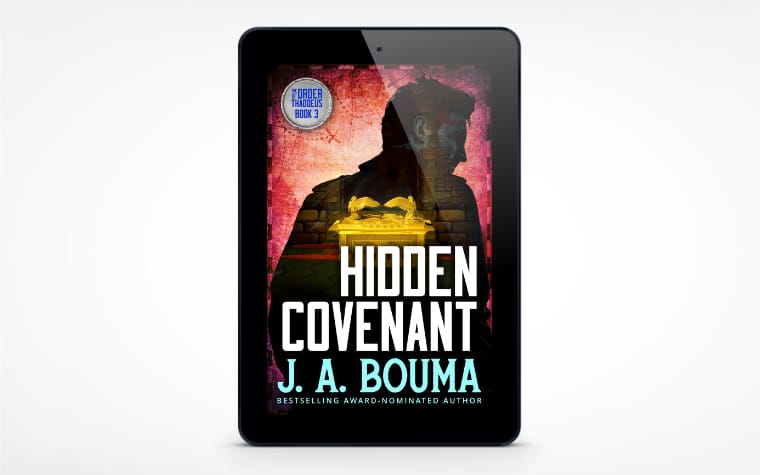
As with all of my novels, I root them in a bedrock of exhaustive research and historical fact. The same was true for my latest religious conspiracy thriller, Hidden Covenant—a propulsive adventure on the trail of the fabled lost Ark of the Covenant. Here are some of those important facts about that lost Jewish relic:
FACT: the Ark of the Covenant was a real religious object, a wooden box overlaid with gold and crowned with two golden cherubim. FACT: the Ark served as the central religious artifact of the ancient Israelites for worship and sacrifice. FACT: around 586 BC the Ark vanished from Israel’s temple, never to be seen again.
So what happened to it and where did it go?
Here is some of the research I discovered that made its way into Hidden Covenant that informed some of Silas Grey’s adventure—and some of the theories answering our questions about what happened to the Ark and where it might be located.
Shishak and Egypt
However, there are good reasons why the Ark probably never made its way to Egypt. Some have maintained that Shishak never entered Jerusalem since it wasn’t among his own list of captured cities. Others believe those temple treasures were merely the gold and other valuables stored in the treasury outside the Temple, not the sacred ones from the inner sanctuary. And as Silas said, there’s 2 Chronicles 13:11, which says the altar of incense, the menorah, and the table of showbread were still in use in the temple. Further, 2 Chronicles 35:3 shows the Ark itself was still being used as late as Josiah’s reign. He instructed the Levites, “Put the sacred ark in the temple that Solomon son of David king of Israel built,” clearly posing a big problem for this theory.
King Manasseh and Levite Protectors
One scholar, Menachem Haran believes Manasseh would have destroyed the Ark and other Temple vessels in order to fill the Temple with the pagan deities and attendants. However, the Bible doesn’t say Manassah destroyed the vessels—only that he was trying to make changes to the religion through syncretism by incorporating the Canaanite religion into the traditional religion of Israel. This leads Randall Price and others to conclude that he could not have removed the Ark or destroyed it, because it had already been secreted away by Levites who were caretakers of the Temple. This seems to be implied in 2 Chronicles 35:3 when the priests returned the Ark to the purified Temple.
The Babylonian Invasion
1) the Babylonians removed the Ark along with the other Temple treasures from the Temple when they sacked and looted Jerusalem, carrying it back to Babylon as the spoils of war;
2) the Ark was either destroyed when the Babylonians destroyed the Temple or destroyed when it reached Babylon, being stripped of its gilding and melted down for the imperial treasury.
There are several reasons why either theories don’t make sense, mostly because the listed of captured Temple treasures didn’t include theArk (2 Kings 25:13–17; Jeremiah 52:17–23) and all the vessels taken from the Temple were later returned by the Persians when Israel returned from exile (Ezra 1:7–11).
A final theory is similar to the one above regarding King Manassah and the Levite protectors: if the ark was not stolen or destroyed by the Babylons, then perhaps it was secreted away beforehand—removed from the inner Temple and hidden away for safe keeping. The caretakers of the Temple could have moved it secretly sometime before Babylon invaded the city and brought to a secret chamber constructed for such a time, all in order to keep it safe for a leter reappearance. This has led many to believe it is still hidden within a secret chamber beneath the Temple Mount.
Menelik and Kebra Negast
Now, what the Bible does not say, but the Kebra Nagast suggests is that King Solomon gave the Queen something else, a son named Menelik. This ancient manuscript tells this story about the birth of their son, as well as the legend of Menelik abducting the Ark from the First Temple in Jerusalem and bringing it to Aksum in Ethiopia.
Ethiopia and the Ark
When in the fourth century Christianity came to their lands, King Evan and the entire Kingdom of Aksum came to faith in the death and resurrection of Jesus Christ. According to the legend, shortly after that, they seized the Ark for themselves and took it to Aksum, placing it in the great church dedicated to Saint Mary the Mother of Christ.
But there are problems with the account, not the least of which is there is no such record in the biblical and extrabiblical Jewish sources. There are doubts that the Queen of Sheba had been an Ethiopian. Many question whether the Ethiopian civilization could have been advanced enough to have engaged with ancient Israel. Then there is the issue of Aksum itself since it wasn’t even in existence during Solomon’s time. Therefore, most believe the legend of the Ark having been brought to Aksum simply isn’t possible. However, every Ethiopian church does indeed have its own replica of the Ark, called a tabot. Some are made of wood, but most are made of stone.
So Where Is the Fabled Ark of the Covenant?
Your guess is as good as mine!
Archaeologist Randall Price represents a number of people who seem to think the Ark of the Covenant lays hidden underneath the Temple Mount in a chamber beneath the original Holy of Holies. Several decades ago, an original passageway was discovered in July of 1981 by the Chief Rabbi of the Western Wall, rediscovering the lost Warren’s Gate and a passage behind it quite by accident. This was an important find, for the Warren’s Gate was one of the original gates leading into the Temple Mount directly into the Temple courts and was used for bringing in wood, sacrifices, and other materials needed for the ancient sacred rites of the Jewish people in the Temple.
Those who have considered the location of the Temple treasures agree this gate is the most important of all because it is the nearest one to the former location of the Most Holy Place where the Ark of the Covenant used to reside. Many scholars of the Semitic period believe that underneath this locale King Solomon constructed a secret chamber to act as a secure vault for the Temple treasures should the need arise to steal them away, perhaps even in the event of the Temple’s destruction. And these biblical scholars believe the Ark was secreted away during a few possible instances with the intention of later returning it to its proper place within the Temple—during the reign of Manasseh and before the Babylonian invasion.
Jewish tradition holds that the Ark has continued to exist in hiding and that it would be rediscovered and restored to Israel when the Messiah appeared. The longest of the Dead Sea Scrolls, known as the Temple Scroll, speaks of this very thing. It describes a new future Temple that will eventually be built containing the Ark of the Covenant. If such a holy place was to be considered legitimate, it must include the Ark, for without it the glory of God cannot return to take its appointed place between the glorious wings of the cherubim. No Ark, no true Temple. And this same Jewish tradition tells of the Ark being hidden away safely and secretly.
Is the Ark under the Temple Mount, then? “The historical accounts support the tradition that the Ark is presently hidden beneath the Temple Mount,” Randall Price insists. “If it was indeed stored away in the past—and has not yet been removed from its hiding place—then it must still remain under the Temple Mount today” (149). After several intriguing chapters in Searching for the Ark of the Covenant, he concludes with this: “No conclusive evidence exists for the existence of the Ark, nor can its hiding place be definitively located. Yet our survey of the biblical, historical, and traditional sources provide sufficient warrant for us to conclude that the Ark still exists and could be discovered” (207).
Perhaps the hidden Ark will one day be revealed!
Hancock, Graham. The Sign and the Seal. New York: Crown Publishers, 1992. www.bouma.com/ark1
Haron, M. “The Disappearance of the Ark.” Israel Exploration Journal 13, January (1963), 46-58. www.bouma.us/ark2
Price, Randall. In Search of Temple Treasures. Eugene, OR: Harvest House Publishers, 1994. www.bouma.us/ark3
Price, Randall. Searching for the Ark of the Covenant. Eugene, OR: Harvest House Publishers, 2005. www.bouma.us/ark4
Read the book inspired by faith + history
Hidden Covenant | Order of Thaddeus 3
Join My Reader Club. Get a Free Book
- Exclusive discounts and special offers
- Early access to new books or events
- Behind-the-scenes articles, updates, and inspiration